
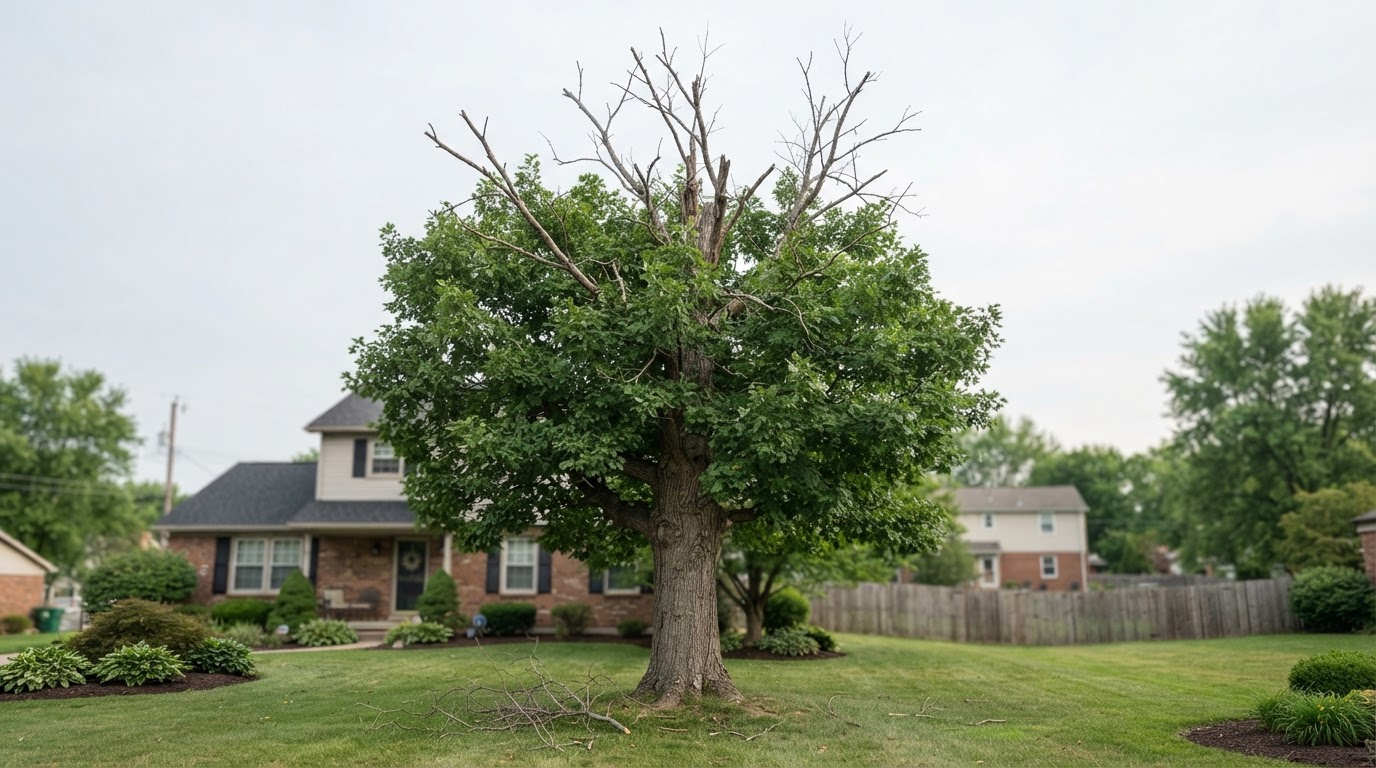
Trees add beauty, shade, and real value to a property — until they become a liability. Across the Greater Cincinnati Tri-State, mature trees face wind, ice, saturated soil, age, and disease that can quietly turn a healthy shade tree into a hazard. The good news is that most trees give warning signs before they fail. Learning to recognize those signs can help you protect your home, your family, and your neighbors — and make a more informed decision about when to call a professional. This guide walks through seven warning signs that a tree may need attention, explains what each one can mean, and helps you understand when a professional evaluation makes sense.
1. Large Dead or Dying Branches
Look for large limbs that have lost their leaves out of season, show no buds in spring, or have bark peeling and falling away. Dead wood often snaps easily and lacks the flexible sway of a healthy limb.
Dead branches can fall without warning, and a heavy limb dropping onto a roof, driveway, playset, or person can cause serious injury or property damage. Mature oaks, maples, and ash are common throughout Southeast Indiana, Northern Kentucky, and Southwest Ohio — and their limbs are heavier than most people expect.
A tree with one or two dead branches may simply need selective pruning to remove the hazardous limbs while preserving the healthy tree. A professional can assess whether the dead wood is isolated or part of a larger decline. If a dead branch is hanging over your home, a walkway, a driveway, or anywhere people gather, have it evaluated promptly.
2. A Tree That Is Suddenly Leaning
Watch for a tree that has begun to lean more than it did before, especially if that lean developed quickly after a storm or a period of heavy rain. Also look for soil that's cracked or heaved on the side opposite the lean — a sign the root plate may be lifting.
A sudden lean often means the root system has been compromised, whether by saturated soil, wind, construction damage, or decay. A tree that was previously upright and has started to lean is far more likely to fail than a tree that grew naturally at an angle.
Many trees grow naturally at a slant and are perfectly stable. The key word is 'sudden.' A tree that has always leaned may be fine; a tree that is newly leaning deserves attention. If the lean is new, worsening, or accompanied by lifted or cracked soil, call before the next storm.
3. Cracks or Splits in the Trunk
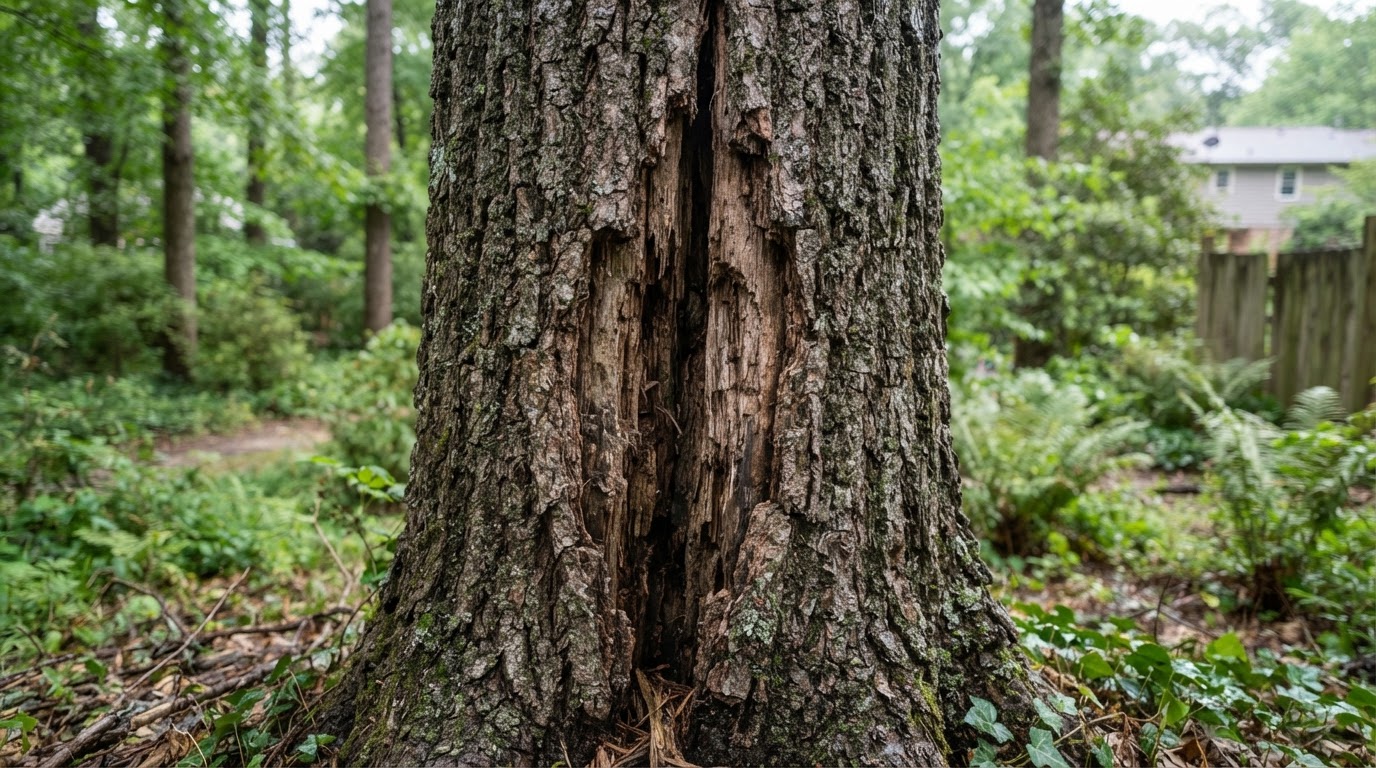
Look for visible vertical cracks running up the trunk, a split where two large leaders have begun to separate, or bark peeling away to expose cracks underneath. A crack that extends into the wood — not just the bark — is the most serious.
A deep crack is a structural defect. Under wind load, a cracked trunk can split open or fail entirely. Co-dominant trees, those with two main trunks or leaders, are especially prone to splitting, and many common Tri-State shade trees grow this way.
Small surface cracks or a tree with otherwise sound structure may be manageable with cabling, bracing, or selective pruning to reduce weight on the weak point. But any visible crack in the main trunk warrants a professional evaluation, especially before the next high-wind event.
4. Visible Decay, Cavities, or Fungal Growth
Look for hollow areas or cavities in the trunk, mushrooms or conks growing on the bark or at the base, and bark falling away in large sections. Wood that feels soft or punky when tapped can also signal internal decay.
Decay weakens a tree from the inside out, and a tree can be substantially hollowed and still leaf out normally. Fungal growth on the trunk or roots often means decay is present — and root decay is one of the most common reasons mature trees uproot in storms.
Trees can survive with some internal hollowing, and not every cavity is dangerous. But the extent and location of the decay matter, and a professional can judge whether the remaining structure is sound. Mushrooms at the base, large cavities, or soft wood are all reasons to get a professional opinion.
5. Exposed, Damaged, or Uprooted Roots
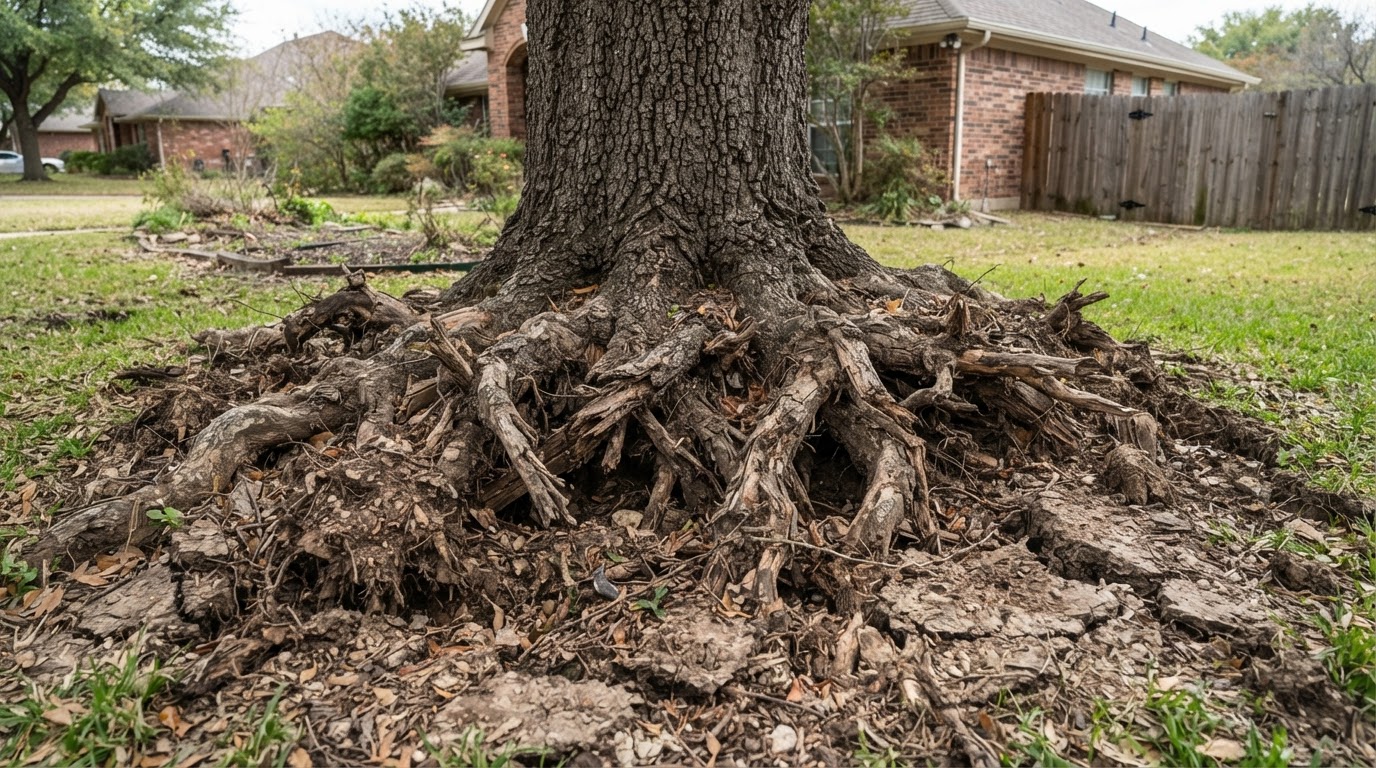
Look for roots that have become exposed due to soil erosion, construction, or grade changes; roots that have been cut or damaged by trenching, driveway installation, or excavation; and root plates that have lifted or show cracked soil around the base.
A tree's stability lives in its roots. When roots are cut, compacted, or exposed, the tree loses both anchorage and a portion of its ability to take up water and nutrients. Construction damage is a frequent and overlooked cause of tree failure — a tree can decline for years after nearby work and then fail in a storm.
Minor root exposure may be addressed with mulch and care. But if a large portion of the root zone has been damaged or the tree is already leaning, it may need removal. After any construction, trenching, or excavation within the root zone of a mature tree — or if you notice a tree declining after such work — it's worth an evaluation.
6. Significant Storm Damage
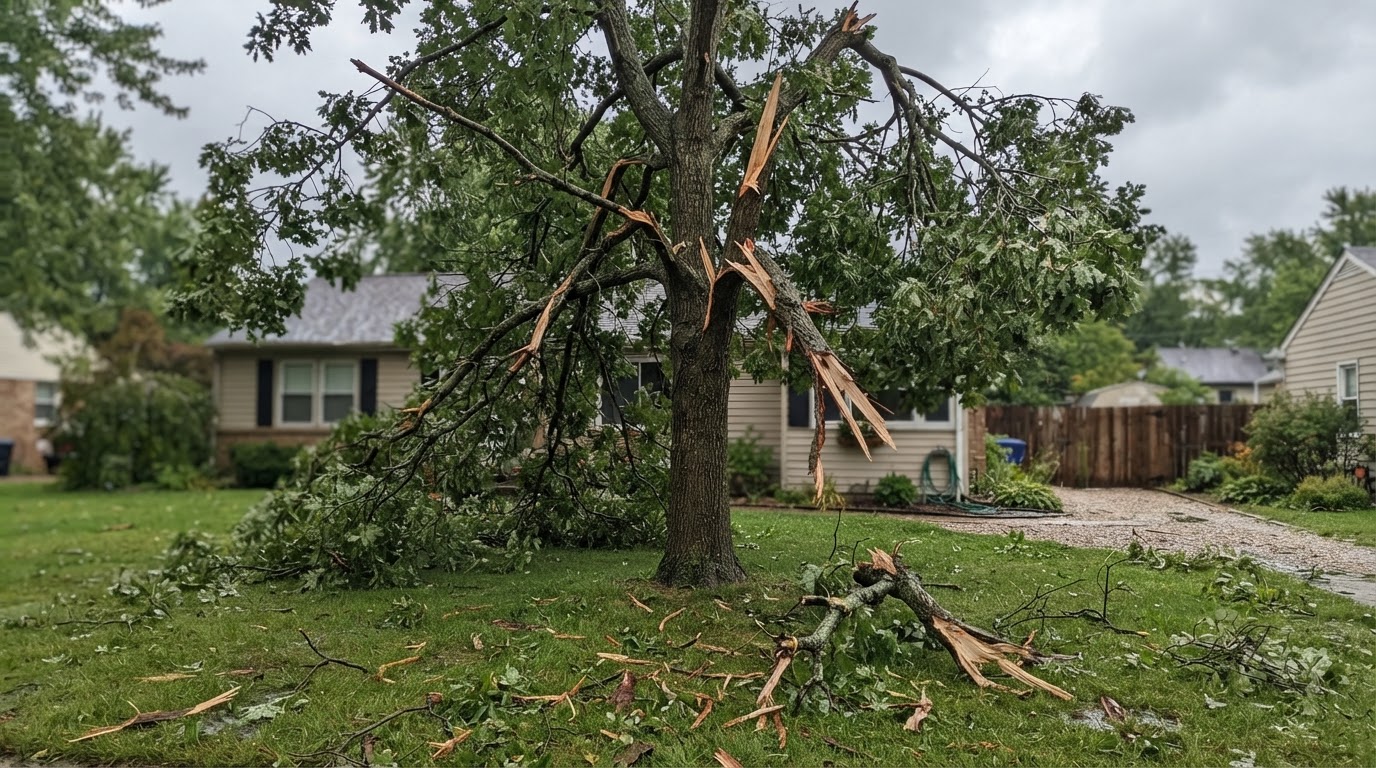
Look for broken or hanging limbs lodged in the canopy, a trunk that's cracked or twisted after a wind or ice event, and trees that have been partially uprooted but are still standing.
Storm-damaged trees are among the most dangerous to handle. They're often under tension, partially supported by other trees or structures, or ready to shift without warning. Across the Tri-State, severe thunderstorms, straight-line winds, and ice storms regularly damage mature trees that seemed fine the day before.
A tree with a few broken branches may recover with proper pruning. The question is whether the trunk and root structure are still sound. If a damaged tree is near your home, power lines, or anywhere people could be, call immediately and keep everyone back from the area.
7. A Tree That Is Dying or Showing Widespread Decline
Look for a thinning canopy, leaves that are undersized or off-color, dieback from the top of the tree downward, bark dropping in large sections, and a tree that leafs out late, drops leaves early, or fails to leaf out at all.
A tree in broad decline is losing structural strength, and dying trees are prone to dropping limbs and uprooting. Across the Tri-State, emerald ash borer and other stressors have killed or weakened many ash, maple, and other mature trees — and a dead tree has nothing left to lose.
Early decline may be reversible if the cause is addressed, such as a nutrient issue, drought stress, or soil compaction. But when more than a third of the canopy is dead or the tree is fully dead, it's a hazard and usually should be removed before it fails on its own.
Can a Dangerous Tree Be Saved?
Not every concerning tree needs to come down. Depending on the problem, a professional may recommend selective pruning or trimming to remove dead, broken, or hazardous branches while preserving the tree, cabling or bracing to support a weak fork or split, correcting soil, drainage, or root issues that are causing decline, or monitoring the tree over time rather than acting immediately.
The goal is to balance safety with preservation — mature trees take decades to replace. But when a tree's structure is compromised beyond a safe margin, removal is the responsible choice. A professional evaluation helps you tell the difference.
Why Professional Tree Removal Matters
Removing a large or hazardous tree is genuinely dangerous work. Large limbs are heavier than they look, trunks store enormous energy when cut, and a tree near a house, power line, fence, or occupied area has very little room for error. Falling limbs, dropped wood, and trees that move the wrong way can cause serious injury or major property damage in an instant.
Professional crews plan each removal around the tree's lean, the surrounding targets, and the safest way to lower each piece to the ground. They use rigging, bucket trucks, and proper technique to take trees apart in controlled sections rather than dropping them whole. For storm-damaged, split, or leaning trees — which may be under tension or ready to shift — that planning is what keeps people and property safe.
This is also why we discourage homeowners from attempting large-tree removal themselves. If a tree is leaning, split, resting on a structure, or anywhere near a power line, please stay back and call for help rather than risk it.
Related Questions
How can I tell whether a tree is dangerous?
Look for dead branches, a sudden lean, trunk cracks, decay or fungal growth, exposed roots, storm damage, and widespread canopy decline. If a tree is near your home or where people gather and shows any of these signs, a professional evaluation is the safest way to know whether it needs removal.
Does a leaning tree always need removal?
No. Many trees grow naturally at an angle and are stable. A sudden or worsening lean — especially with cracked or lifted soil — is the real warning sign. A professional can tell the difference between a tree that has always leaned and one that has become a hazard.
Can a storm-damaged tree recover?
Sometimes. If the trunk and main structure are intact, pruning the broken limbs may be enough. If the trunk is cracked, split, or the tree is partially uprooted, removal is often the safer call. A professional can assess the remaining structure.
When should I call a tree service?
Any time a tree is near your home, power lines, or people and shows signs of failure — dead branches, a new lean, cracks, or storm damage — call. It's always better to get a professional opinion before the next storm rather than after.
Concerned About a Tree on Your Property?
If a tree on your property is showing any of these warning signs, MMM Tree Service can help. We serve homeowners and property owners throughout the Greater Cincinnati Tri-State — including Southeast Indiana, Northern Kentucky, and Southwest Ohio — with tree removal, trimming, and storm-damaged tree cleanup.
Serving the Greater Cincinnati Tri-State. See our service areas or browse more tree-service guides.